PBC / Survival · Radiation emergencies · Source review
Can a backyard hole become a nuclear bunker? What the Short leaves out
A viral explainer gets some fallout principles right, but a buried pipe, a filter and a heavy door are not a verified shelter design.
Published October 25, 2026. Preparedness information—not construction plans, engineering certification or an indication that an attack is imminent.
The practical takeaway
Do not enter an unsupported excavation or improvise an occupied underground shelter from this video. In a radiation emergency, Canadian guidance is to get inside the nearest suitable building, move to its centre or basement, listen for official information and follow instructions. Prepare to shelter for at least 24 hours when directed; that is not an automatic all-clear.
Watch the source Short
Doodles Fact: “How A Hole in your yard can become a nuclear bunker” · approximately 98 seconds · uploaded October 24, 2026.
Simplified creator explanation, not a tested or approved bunker plan. The thumbnail is illustrative artwork, not evidence of a functioning shelter.
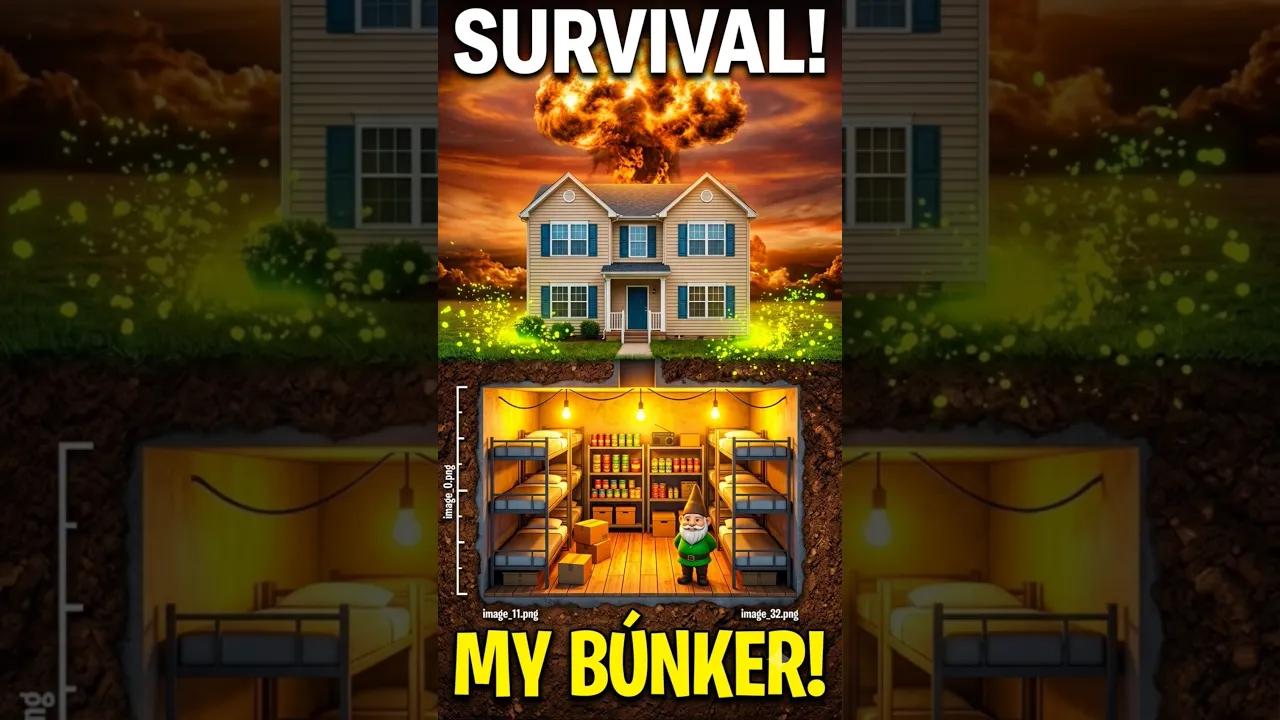
Watch directly on YouTube. Metadata, thumbnail and captions were recovered. Full local video download failed with HTTP 403; this page uses the original YouTube player.
Fallout shielding is not blast resistance
The Short moves from a hole to a buried steel pipe, bent entrance, filtered ventilation, blast valve, door and escape hatch. These address recognizable hazards, but naming the components does not show that the assembled shelter can withstand a particular explosion or remain habitable.
FEMA distinguishes blast, heat, initial radiation and radioactive fallout as different hazards. A shelter that reduces fallout exposure is not necessarily capable of surviving nearby blast damage, fire or structural collapse. The video supplies no verified structural calculations, material specifications, tested pressure rating or site assessment.
Excavation itself is dangerous even without an emergency. WorkSafeNB identifies cave-ins, utility strikes, water and hazardous atmospheres as risks requiring controls. Its guidance is a provincial workplace example—not a national backyard-building code. Before considering an underground project, consult qualified structural/geotechnical professionals and the local building authority about soil, groundwater, utilities, permits, loads, ventilation and emergency exits.
The “three feet stops 99.9%” claim needs qualifications
Earth and other substantial materials can reduce radiation exposure. The EPA explains the general principles of time, distance and shielding. But the Short presents a single soil thickness as though it guarantees whole-shelter protection.
Conditional arithmetic, not design validation: if every 3.5 inches halved the relevant radiation intensity, 36 inches would give approximately 99.92% attenuation in that simplified calculation. That checks the video's arithmetic under its assumption; it does not establish that 3.5 inches is a universal half-value thickness, or that an occupied shelter actually achieves that reduction. Material properties, radiation energy and the complete shelter geometry matter. A doorway, penetration or inadequately shielded surface cannot be ignored.
The bent-entrance idea recognizes a real shielding problem, but “radiation travels in straight lines” is not a complete shielding analysis. Do not interpret two bends as a guarantee of zero exposure. This review does not certify the video's dimensions or construction choices.
Filters, doors and meters are not magic safeguards
A dust filter addresses particles in incoming air; it is not a substitute for shielding against penetrating gamma radiation. Long-term occupancy also needs engineered ventilation, heat management and safe air quality. Briefly minimizing outside air during an official shelter-in-place instruction is not permission to seal people indefinitely inside a small underground chamber.
The Short also describes a fast-closing blast valve and an outward-opening blast door. Neither response time nor opening direction alone establishes a pressure-rated assembly. The door, frame, anchorage, ventilation penetrations and escape route need to work as a system. No independent performance testing for the illustrated design was provided in the recovered source.
A Geiger counter can detect radiation, but clicking is not an all-clear signal. The US Nuclear Regulatory Commission explains that instruments differ in what they measure and that accurate exposure measurements require suitable calibration. A device reading must be interpreted for its instrument, range and purpose; it cannot replace official instructions about sheltering or evacuation.
The seven–ten rule is real; the two-week conclusion is not guaranteed
The DHS responder guide describes the approximate seven–ten rule: for each sevenfold increase in time after a nuclear detonation, fallout radiation dose rate decreases about tenfold. Using the one-hour rate as a reference, the rule estimates roughly one-tenth at seven hours and one-hundredth at 49 hours.
This is a rule of thumb for decaying fallout, not a universal rule for every radiation emergency or a promise that a location is safe. A percentage reduction does not tell you the remaining dose rate without a starting level. Continued deposition or further releases also change the situation.
The Short concludes that “you only need supplies for two weeks.” A two-week stock of supplies may help resilience, but the decay rule alone cannot establish a universal maximum sheltering period, resupply date or safe exit time. FEMA's public nuclear-explosion sheet says to stay inside for 24 hours unless local authorities provide other instructions. Canada's guidance similarly emphasizes at least 24 hours when instructed and following local directions. Neither means everybody should leave at a fixed hour.
A safer Canadian preparedness checklist
- Identify shelter now: locate a basement or interior area of a substantial building near home, work and school. Do not plan to excavate after an alert.
- Prepare essentials: drinking water, packaged food, required medicines, a flashlight and a battery-powered or hand-crank radio; account for children, pets and medical needs.
- During an alert: get inside, stay away from exterior walls and windows, and follow official shelter or evacuation directions. An unsafe building, fire or other immediate life-threatening hazard changes the decision.
- Limit contamination: follow official advice on removing contaminated outer clothing and washing exposed skin. Do not confuse dust removal with stopping all radiation.
- Do not self-prescribe potassium iodide: Canadian guidance says to take it only when public-health authorities instruct you; it is useful only in specific situations and timeframes.
Bottom line: the useful lesson is shielding, time and preparedness—not “bury a pipe and you have a safe nuclear bunker.” Use the Short as an introduction to questions, not as a building specification or a countdown to safety.
Sources and evidence trail
- Doodles Fact — source Short. Caption transcript, metadata and illustrative thumbnail reviewed; no complete local MP4 recovered.
- Public Safety Canada — radiological and nuclear emergencies. Canadian shelter, emergency kit, evacuation and KI guidance.
- FEMA / Ready.gov — nuclear explosion information sheet. Distinct hazards and public sheltering guidance; PDF recovered and read.
- DHS — radiation risk information for responders. Seven–ten rule and the importance of radiation monitoring. Responder guidance is not a DIY construction manual.
- EPA — protecting yourself from radiation. Time, distance and shielding.
- NRC — what a Geiger counter measures. Detection, instrument differences and calibration limits.
- WorkSafeNB — excavations and trenches. Cave-ins, utility identification, water and atmospheric hazards; New Brunswick workplace context.
Method: captions cover the supplied Short to approximately 1:35 of its 1:38 metadata duration. No frame-by-frame review or tested shelter performance is claimed. The arithmetic above is expressly conditional. Captured caption transcript · Capture and review note.