Speech Watch · Canada · Source check · September 19, 2026
Filming homelessness: a real petition, not a new Canadian law
A Rogue Lawyer TikTok warns that Canadians could be punished for documenting conditions on their streets. The matching public proposal is real—but its legal status matters. A citizen petition asking Parliament for a new offence is not an introduced government bill or an offence already in force.
The original clip
The TikTok account @roguelawyer is identified by the platform as Phillip Millar; his own website also uses “The Rogue Lawyer and Business Consultant.”[5] The clip’s caption uses the future-facing phrase “could soon face punishment.” The spoken commentary goes further: it refers to a government “bill” and says that “now” in Canada people cannot film street conditions “or you can go to jail.” No bill number, statutory section or prosecution is identified in the clip.
@roguelawyer You could soon face punishment in Canada for documenting what our streets have become, as the government moves to censor the true state of our country
♬ original sound - Phillip Millar
Source: the original Rogue Lawyer TikTok, dated September 18, 2026 in platform metadata. This is the claim being examined, not legislative evidence. TikTok playback depends on the platform and browser; use the direct link if the player is unavailable.
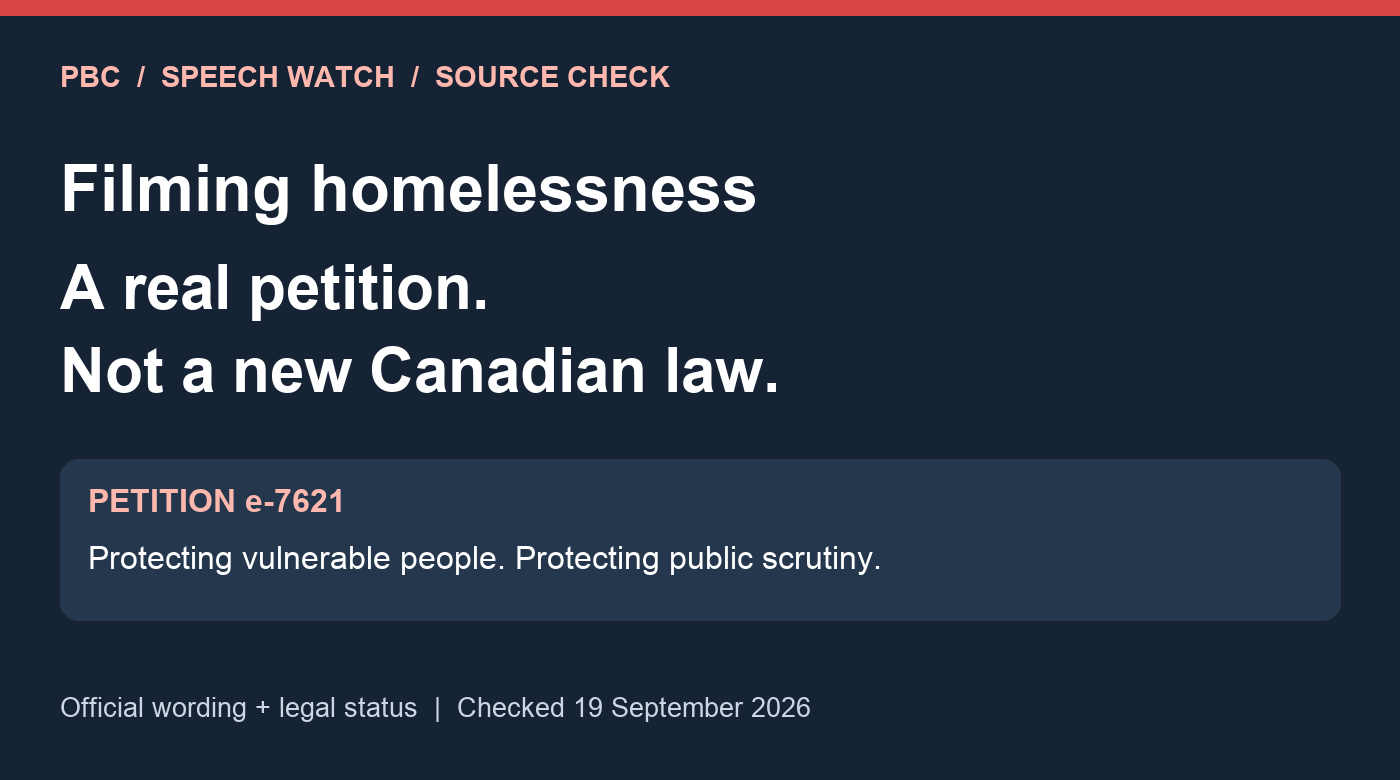
What petition e-7621 actually requests
The official House of Commons page contains a citizen-initiated petition, e-7621 (Justice), requesting a new Criminal Code provision. Its operative request is to make it an offence to:
“knowingly record in public, a person the recorder knows is experiencing ‘prescribed circumstance of significant vulnerability’ for the purposes of publishing or distributing that recording to the public.”
The quoted wording is the petition’s request, not text from an enacted criminal offence. The petition lists homelessness, a mental-health or other acute psychological crisis, significant impairment from alcohol or drugs, and other prescribed circumstances substantially increasing vulnerability to exploitation or serious harm from public exposure.[1]
That is more specific than a ban on all street photography: it includes knowledge of the person’s circumstances and a purpose of public distribution. It is also potentially broad. The request is not expressly limited to recordings made to mock someone, exploit them commercially or conceal government misconduct. Nor does its operative wording set out an explicit journalism, public-interest, incidental-capture or consent exception. Lack of knowledge and consent is mentioned in the rationale; that is not the same as a drafted consent exception.[1]
A petition is not a bill—and sponsorship is not government adoption
The page identifies Liberal MP Arielle Kayabaga of London West as its parliamentary sponsor. That is relevant public information, but it does not establish that the Liberal government has introduced or adopted the requested offence.[1]
The House’s own petition guide explains that an MP must authorize an e-petition’s publication and that, by doing so, the member does not necessarily endorse its views or information. A petition is a request for action; it follows a petition-certification, presentation and response process, not the passage of a bill.[2] A bill follows separate legislative stages, including readings, parliamentary consideration and Royal Assent; its commencement may be immediate or later.[6]
In this review, PBC did not identify a matching introduced federal bill, enacted provision or prosecution establishing the new blanket prohibition suggested in the clip. We checked the petition record, targeted parliamentary searches and the current-session LEGISinfo bill-title catalogue; individual bill texts and amendments were not exhaustively searched.[1][7] The clip supplies no bill number to verify. We therefore identify e-7621 as the matching public proposal we located—not as proof that Millar was quoting this exact petition or that no other proposal could exist.
There is no penalty or jail term specified in the petition’s request. A possible future criminal offence should be debated seriously, but “a petition asks for an offence” and “you can now go to jail under that offence” are different claims.[1]
Why supporters want protection
The petition describes concerns about exploitation, stigma, people being exposed online during crises, and risks to people who may be escaping domestic violence or face sexual exploitation. It also argues that vulnerable people may lack resources to pursue existing remedies. These are the petitioners’ stated reasons; they should not be replaced by an assumed motive to hide government failure.[1]
There is a real ethical distinction between documenting public conditions and turning an identifiable person’s lowest moment into humiliating entertainment. A person’s homelessness or illness does not erase their dignity. Equally, recognising that harm does not settle whether a broadly framed criminal offence is the best or most proportionate response.
Why the wording still deserves scrutiny
PBC’s concern is not that the petition already bans recording. It is that the requested rule leaves important questions unanswered:
- Would it protect reporting about dangerous conditions, public-service failures or official conduct?
- How would “significant vulnerability” and the recorder’s knowledge be established?
- What happens when a person appears incidentally in a wider streetscape or public event?
- How would consent, public interest, evidence gathering and emergency situations be addressed?
- Could a person’s own account of homelessness be recorded and shared with their permission?
- Why would existing remedies be insufficient, and what narrower options have been considered?
Those are policy and drafting questions arising from the proposed wording, not findings by a court. The claim that the government is deliberately using compassion to conceal its failures is the speaker’s political interpretation; the petition record does not prove that motive.
Free expression matters; “anything goes in public” is too broad
Section 2(b) of the Canadian Charter protects freedom of expression, including freedom of the press and other media of communication. Section 1 permits only reasonable limits prescribed by law that can be demonstrably justified in a free and democratic society. Those provisions make speech and reporting central to this debate, but they do not let us declare an unwritten future offence unconstitutional in advance.[3]
Nor does the absence of this proposed new offence mean every recording or publication is lawful. For a B.C. example, the provincial Privacy Act makes certain wilful violations of privacy a civil wrong, with the reasonable expectation of privacy assessed in context. It provides a public-interest publication exception, while expressly stating that this does not excuse a separate privacy violation in how the material was obtained. That is a civil-law framework—not the new federal filming offence the petition requests.[4]
This article is not permission to harass, trespass, disregard a court order, or assume that a public location removes all privacy concerns. Legal questions depend on the conduct, place, purpose and applicable law.
Claim-by-claim
Supported: e-7621 requests a new Criminal Code offence with the elements described above.[1]
Not established by the evidence supplied in the clip or the matching petition record. An MP’s authorization of a petition is not government adoption.[1][2]
Not supported by this petition. It creates no offence and specifies no penalty.[1][2]
A legitimate question about scope, not a demonstrated enforcement outcome. The petition’s operative request does not expressly state a journalism or public-interest exception.[1]
PBC’s position
Protect vulnerable people from exploitation without making visible social problems harder to document. If a government takes up this request, it should publish precise proposed wording, explain the evidence for a new offence and address legitimate journalism and public-interest recording directly.
Readers do not need an inaccurate “already law” warning to question this proposal. The actual petition provides enough substance for a serious debate about dignity, privacy, accountability and freedom of expression.
Sources and reporting method
- [1] House of Commons: petition e-7621
- [2] House of Commons: electronic petitions guide
- [3] Justice Canada: Charter of Rights and Freedoms
- [4] British Columbia: Privacy Act
- [5] Phillip Millar: first-party biography
- [6] House of Commons: legislative process
- [7] LEGISinfo: current-session bills catalogue
We downloaded the source clip, checked its caption and on-screen text, and used an automated timestamped transcript to identify the spoken claims. The full working video and transcript remain local; the public package contains limited claim excerpts and original analysis. Signature totals are deliberately omitted because live and cached counts changed during retrieval. No person in crisis is identified or targeted. This is a legislative-proposal source-check, not a report of a court judgment, prosecution or named judge.
Source note · Claim table · Selected clip excerpts · Capture metadata