PBC civil liberties · Emergencies Act · source-check · August 18, 2026
Freedom Convoy bank “blacklist”: what the new documents claim, what the courts already ruled
A viral graphic points to a real scandal-class civil-liberties question: how far did Ottawa’s 2022 account-freezing data travel, and why were private financial networks turned into enforcement arms before courts later ruled the legal threshold was not met?
What the graphic claims
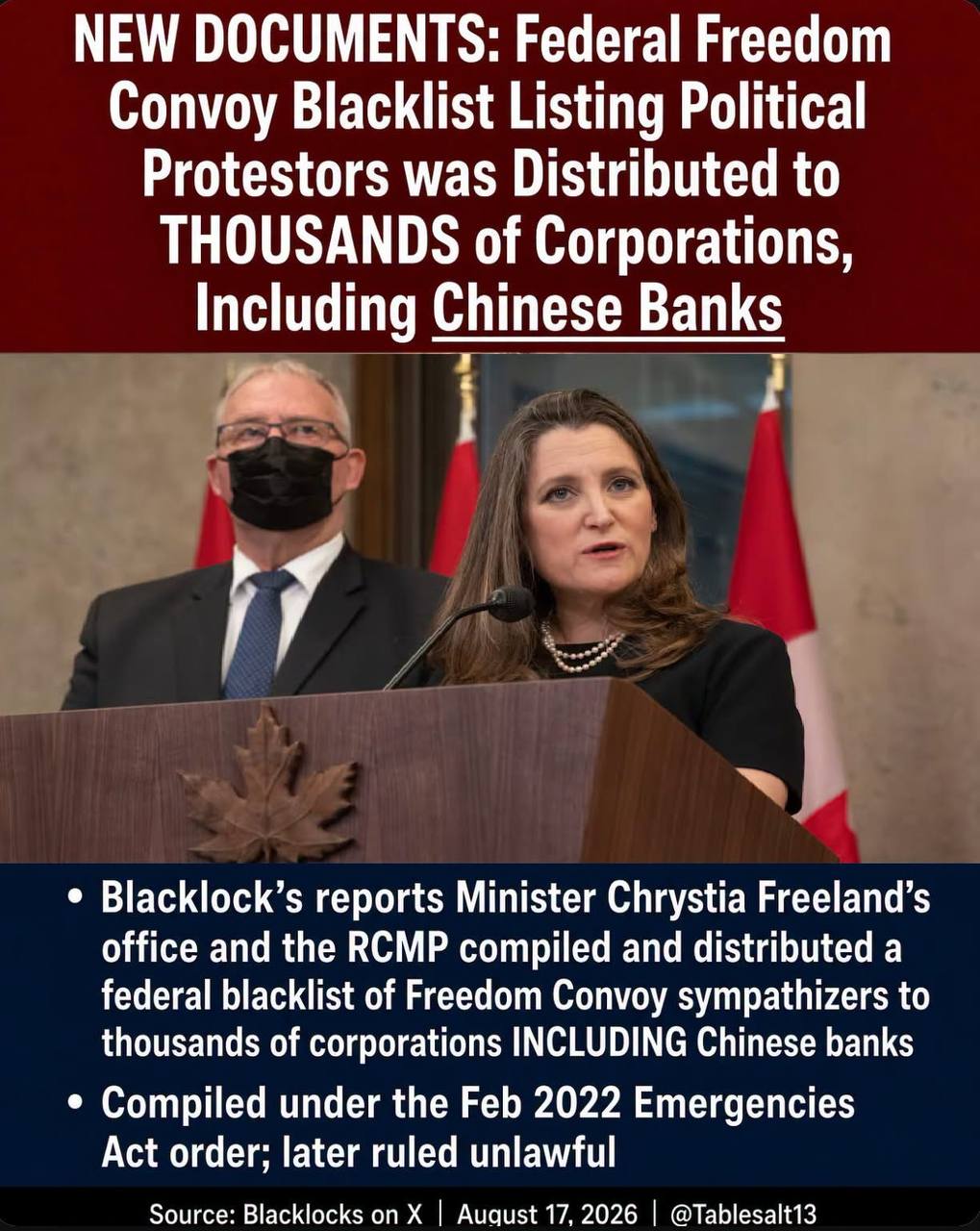
The user-supplied poster says “new documents” show a federal Freedom Convoy blacklist listing political protestors was distributed to thousands of corporations, including Chinese banks. It attributes the claim to Blacklock’s on X, August 17, 2026, and says Minister Chrystia Freeland’s office and the RCMP compiled and distributed a federal blacklist of Freedom Convoy sympathizers under the February 2022 Emergencies Act order.
PBC preserved the image as claim evidence below. A graphic is not a document package, so the article separates what is official, what is accessible reporting, and what still needs release.
The official order really did pull private finance into enforcement
The federal Emergency Economic Measures Order, SOR/2022-22, applied to a broad set of financial entities. It required entities listed in section 3 to determine on a continuing basis whether they held property owned or controlled by a “designated person.” That list included banks regulated under the Bank Act, authorized foreign banks in respect of their business in Canada, credit unions, insurers, trust and loan companies, securities dealers, fundraising platforms and related entities.
The same order required those entities to cease dealings with designated persons, disclose certain information to the RCMP or CSIS, and allowed government institutions to disclose information to entities covered by the order if the institution was satisfied the disclosure would contribute to applying the order.
The court ruling is not just old commentary — the FCA confirmed it
The Federal Court of Appeal’s January 16, 2026 plain-language summary for Attorney General of Canada et al. v. Canadian Civil Liberties Association et al., 2026 FCA 6, says the federal government’s invocation of the Emergencies Act was unreasonable and ultra vires, meaning beyond legal authority. It also says the measures infringed Charter paragraph 2(b) and section 8.
Most important for the bank-account issue: the FCA summary says the Economic Order’s implementation was “ad hoc” and “fraught with confusion,” requiring financial institutions to disclose property they had “reason to believe” was connected to a designated person without a warrant or specific procedures. The Court said sections 5 and 6 of the Order were not reasonable within the meaning of section 8.
What the new Blacklock’s-linked reports say
Accessible coverage of the Blacklock’s document claim says the distribution went farther than the government’s earlier public assurances suggested. The Post Millennial article captured by PBC says:
- Ontario regulators circulated the blacklist to between 1,000 and 2,000 firms and brokerages.
- No restrictions had been placed on the list’s distribution, according to federal records first obtained by Blacklock’s Reporter.
- The RCMP had compiled information including names, birth dates, phone numbers and other personal information and distributed the list by unencrypted email.
- The blacklist was reportedly shared with up to 50 financial institutions and lobby groups, including the Canadian Bankers Association and Mutual Fund Dealers Association.
- Regulators including the Canadian Securities Administrators, IIROC and Ontario Securities Commission were reportedly given the list and then forwarded information to thousands of members.
- A 2023 Inquiry of Ministry tabled in the Commons reportedly said the RCMP sent the blacklist to Canadian agents in foreign institutions located in foreign banks, including in China, India, France, the United States, Pakistan, Japan, South Korea and others.
Those points make this a records-release story. If the list touched foreign-bank channels or thousands of private firms, Canadians should see the distribution path, restriction language, retention instructions, deletion/audit logs, and the legal opinion that authorized the disclosure.
Claim table
| Claim | Evidence label | Finding |
|---|---|---|
| The graphic says Blacklock’s reported a Freedom Convoy blacklist went to thousands of corporations including Chinese banks. | Confirmed claim | OCR/vision captured the source line and exact poster wording. |
| The 2022 order empowered/required a broad class of financial entities to act. | Confirmed official record | SOR/2022-22 covered banks, authorized foreign banks operating in Canada, credit unions, insurers, securities firms, fundraising platforms and others. |
| The Emergencies Act invocation/order was later ruled unlawful/unreasonable. | Confirmed with precision | The FCA said the invocation was unreasonable and ultra vires, and that the Order infringed Charter section 8. |
| The list went to thousands of firms and foreign banks including China. | Reported from Blacklock’s/new federal records via accessible coverage | Post Millennial/Juno-style coverage reports 1,000–2,000 Ontario firms, up to 50 institutions/lobby groups, and foreign-bank channels including China. Underlying Blacklock’s documents were not directly retrieved here. |
| The poster proves the CCP received Canadians’ protest data. | Not proven | The source trail raises a foreign-bank data-sharing question, not proof of CCP receipt or use. |
| Every listed person was merely a peaceful political protestor. | Overbroad | Individual file status requires the list and context. The civil-liberties issue remains serious even without flattening every person into one category. |
What records should be released now
- The full distribution list: every bank, regulator, association, brokerage, securities firm and foreign-bank office that received convoy-linked personal data.
- The exact fields shared: names, dates of birth, phone numbers, addresses, vehicle/company details, account identifiers or other personal information.
- Whether the list included donors, sympathizers, companies, organizers, drivers, trucks, or only persons designated under the order.
- Who authorized each disclosure: Finance, RCMP, Public Safety, FINTRAC, regulators, or another office.
- Whether foreign-bank recipients were limited to Canadian agents/branches or included overseas locations.
- Deletion, retention and audit logs after the emergency ended and after the FCA ruling.
- Whether anyone was notified they were listed and given a correction/appeal route.