SPEECH WATCH · ALBERTA · CAMPUS FREE EXPRESSION
Lethbridge lecture cancellation quashed: a real Charter win for speakers and listeners
Published 18 September 2026 · Pickle v University of Lethbridge, 2026 ABKB 659 · Justice C.D. Simard
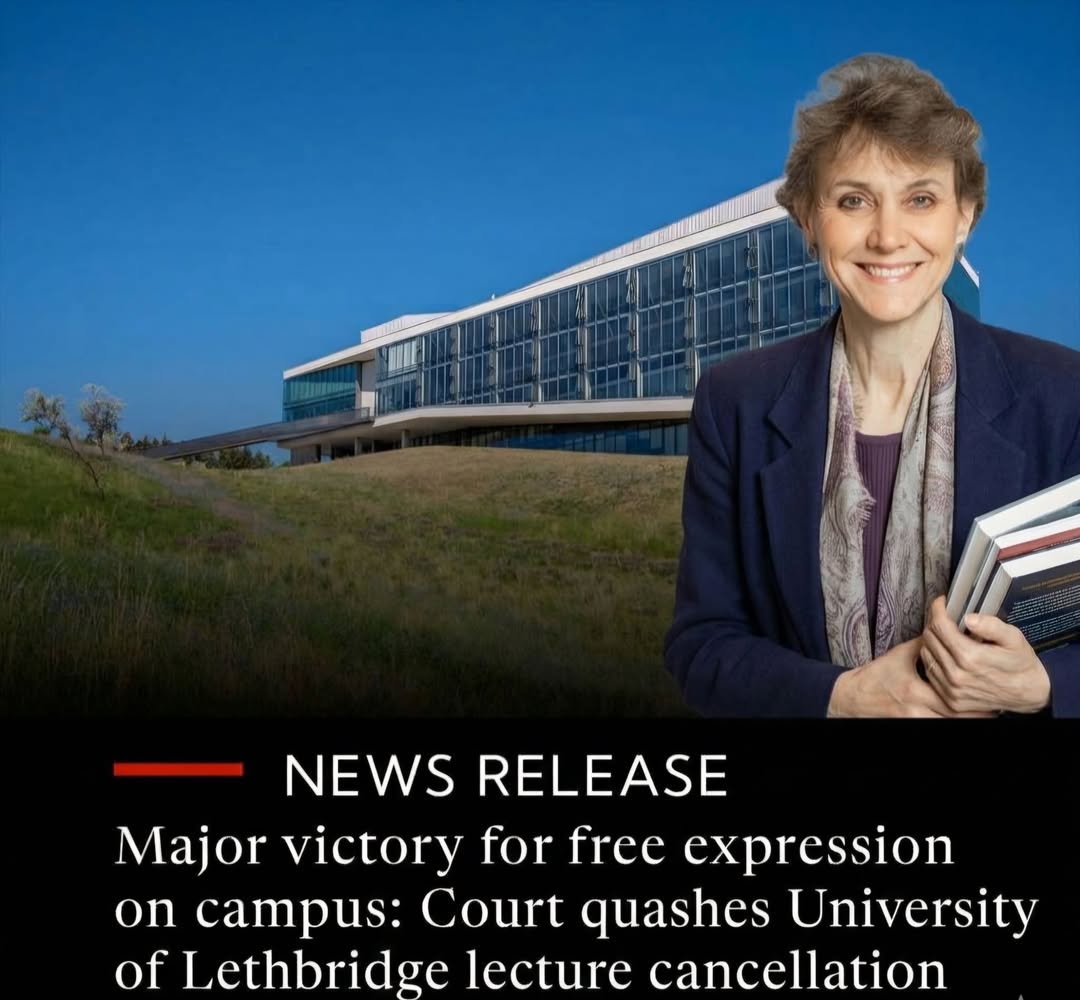
The Facebook post’s central claim checks out. Alberta’s Court of King’s Bench has set aside the University of Lethbridge’s decision to cancel Frances Widdowson’s February 1, 2023 campus lecture. This is a consequential free-expression victory: the university could not regulate this student-facing expressive activity while leaving the Charter out of its decision-making.
Verdict: The cancellation was quashed because the university failed expressly to consider the applicants’ section 2(b) Charter rights. The protection extended to student Jonah Pickle as a listener and Widdowson as an invited speaker. The ruling does not order a replacement lecture, resolve later trespass matters, or endorse her opinions.
What the court actually decided
The reasons are Pickle v University of Lethbridge, 2026 ABKB 659, Calgary docket 2301 09854, signed by Justice Christopher D. Simard on September 17, 2026, after an April 10 hearing. PBC reviewed the full 22-page PDF, including its filing stamp and concluding orders, rather than relying on the social-media headline.
Paragraphs 50 and 61 supply an important boundary. The judge did not decide that the university is government for everything it does. He found that this particular cancellation was governmental in nature because it regulated students’ freedom of expression on campus. Calling the dispute a room-booking matter did not remove its constitutional substance.
That distinction strengthens, rather than diminishes, the result. A public institution’s administrative label is not the last word when a decision suppresses an otherwise authorised exchange of ideas. The court examined what the university was actually doing.
The audience has rights too
Paragraph 77 states that freedom of expression “protects listeners as well as speakers.” Pickle’s section 2(b) rights included being able to attend and listen to the event. This was not simply a dispute over one controversial academic’s access to a microphone: a student’s opportunity to hear and assess ideas was also at stake.
For Widdowson, paragraph 81 stresses that a faculty invitation had already given her a platform. Her claim challenged the withdrawal of that authorisation, rather than demanding a new platform she had never been entitled to use. Paragraph 82 expressly leaves uninvited visitors and academic staff’s different circumstances outside this case. It is therefore not a universal right to enter any campus and demand an audience.
The university’s concerns did not replace Charter analysis
The reasons record complaints about Widdowson’s views and the university’s concerns about harm, safety and reconciliation. The disputed public event was titled “How Woke-ism Threatens Academic Freedom.” Two separately arranged in-class lectures were not cancelled. That context matters: the challenged decision concerned this public lecture, not every appearance she had planned.
Universities may face genuine competing responsibilities. But in paragraphs 83–84, applying the Supreme Court of Canada’s York decision, Simard held that acknowledging freedom of expression in general terms was insufficient. The university had not expressly identified and considered the Charter rights engaged. That omission made the decision “fundamentally and fatally flawed.”
The judge expressly did not decide whether the cancellation was reasonable on its merits. Describing the judgment as a court finding that every stated safety concern was fabricated would go beyond the reasons. Equally, reducing it to an inconsequential technicality would miss the point: constitutional rights had to be part of the decision, and their omission invalidated it.
The remedy: a victory with defined limits
- The 2023 cancellation is set aside. That is the operative court-ordered result.
- No compulsory replacement lecture was ordered, and the matter was not sent back for reconsideration. The scheduled event had passed more than three years earlier.
- The requested formal declaration was not granted because the judge did not analyse the decision’s merits. The reasons’ Charter analysis and the remedy must be reported separately.
- Peaceful assembly under section 2(c) was not decided; footnote 1 says that issue was not substantially argued.
- The constitutionality of the Occupational Health and Safety Act was not before this court. This is not a ruling striking that statute down.
- Costs remained unresolved. Paragraph 90 allows submissions if the parties cannot agree within 45 days.
Nor does this judgment overturn a separate 2026 campus trespass ban or arrest. A ruling about the 2023 invited lecture should not be advertised as unrestricted permission for later campus entry. It also makes no finding endorsing Widdowson’s historical views. Protecting expression and agreeing with its content are different questions.
Claim-by-claim
| Claim | Finding |
|---|---|
| The court quashed the lecture cancellation. | Supported: paragraphs 88–89. |
| Speakers and listeners have protected interests. | Supported in these circumstances: paragraphs 77–81. |
| The university must now host the lecture. | Incorrect: the requested injunction was refused. |
| The court decided all campus actions are government actions. | Incorrect: the finding concerns this regulation of student expression. |
What happens next?
CBC’s September 18 report quotes the university saying it was reviewing and analysing the ruling and would issue a further statement. That is a reported university response, not an appeal announcement. PBC has not verified an appeal filing. Future litigation or a newly arranged event would require its own update.
Source package
The full reasons PDF was obtained from the Justice Centre for Constitutional Freedoms website, an advocacy organisation supporting the applicants’ case. It is a court-issued document hosted by that organisation, not a copy independently downloaded from a court server. The social post is a lead, not the judgment.
Source note and provenance · Download claim table · Pruned post caption · Original Facebook lead · Speech Watch. Reader comments and private capture data are not included.