Speech Watch · Quebec courts · online comments · updated 2026-08-17
Mylène Hébert case: real jail sentence and re-detention, but not a simple “arrested for a comment” story
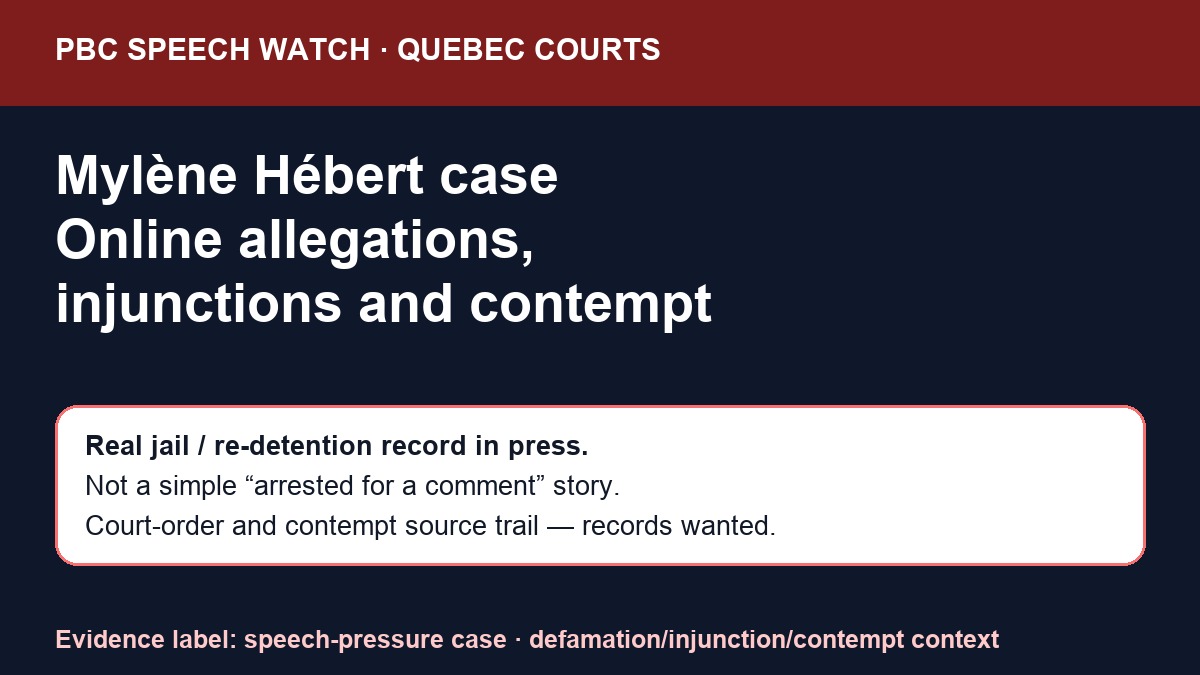
A TikTok asked Canadians to look up Mylène Hébert from Quebec and said her arrest shows people can be jailed for saying the wrong thing. The case is real. The framing needs precision: the public record described by Quebec media is a defamation-injunction and contempt-of-court file arising from social-media publications, court orders and alleged non-compliance.
August 2026 update
- July 13: Vingt55 reports Justice Antoine Aylwin imposed eight months imprisonment and a $10,000 fine after contempt findings in the Alain Carrier / Performance N.C. Inc. defamation-injunction file.
- July 24: Radio-Canada reports Hébert was sentenced to prison in a defamation matter and summarizes the removal/publication/unblocking orders.
- Aug. 6: Vingt55 reports Hébert recovered liberty after agreeing before Justice Desfossés to comply with court conditions / remove targeted content.
- Aug. 10: Vingt55 reports she returned to detention after alleged non-compliance with release/court conditions and remaining or restricted-access content.
What the social-video claim gets right and misses
The claim that this is connected to online speech is partly right: the dispute involves social-media publications. The missing context is the civil defamation/injunction/contempt chain. Press reports say court orders required removal of posts, publication of a judgment on Facebook/TikTok and unblocking access for compliance verification. The imprisonment/re-detention reporting is tied to contempt and alleged non-compliance, not an ordinary one-off comment.
Claim table
| Claim | Evidence label | Finding |
|---|---|---|
| Hébert was sentenced to eight months imprisonment and a $10,000 fine in a Quebec Superior Court contempt matter. | Supported by Radio-Canada + Vingt55; official judgment not retrieved here | Radio-Canada and Vingt55 report an eight-month sentence and $10,000 fine. Vingt55 attributes the sanction to Justice Antoine Aylwin. |
| The case arose from social-media posts. | Supported | Reports say the underlying defamation/injunction file involved social-media allegations about former Drummondville mayor Alain Carrier and related parties. |
| The jail sentence was simply for ordinary opinion or criticism. | Misleading / incomplete | The public record described in reporting is defamation/injunction/contempt enforcement after court orders, not a one-off criminal arrest for a political opinion. |
| The court ordered removal of posts, publication of the judgment on Facebook/TikTok, and unblocking access for compliance verification. | Supported by reporting | Radio-Canada and Vingt55 both describe removal/publication/unblocking requirements tied to the January judgment and later contempt findings. |
| Hébert was released Aug. 6 after agreeing to comply. | Reported Aug. 6 update | Vingt55 reports she accepted conditions before Justice Desfossés and recovered her liberty after agreeing to comply with the judgment. |
| Hébert was returned to detention after alleged non-compliance. | Reported Aug. 10 update | Vingt55 reports a new arrest warrant after alleged failures to remove/restrict content and continuing publications; it attributes the warrant to Justice Katheryne/Catherine Desfossés. |
| Her underlying allegations were proven. | Not proven / reportedly rejected by court | Reporting says the court found the accusations false, non-credible, unfounded, or defamatory. PBC does not repeat them as fact. |
| Named court/judge trail exists for JudgeWatch monitoring. | Yes — source trail, not misconduct claim | Reported judicial/court names include Quebec Superior Court, Bernard Synnott, Thomas M. Davis, Antoine Aylwin, and Desfossés. Official judgments remain wanted. |
Judges and court record to track
The public reporting names or refers to the following court/judicial actors. This is a neutral source trail, not a misconduct allegation.
| Judge / court | Reported role | Next record wanted |
|---|---|---|
| Quebec Superior Court | Defamation, injunction and contempt proceedings | Official judgment texts / SOQUIJ or CanLII records |
| Hon. Bernard Synnott | Reported January defamation/injunction judgment | Official judgment text |
| Hon. Thomas M. Davis | Reported later hearing / default-to-appear coverage | Official docket/judgment text if available |
| Hon. Antoine Aylwin | Reported July contempt sentence | Official 13-page judgment cited by Vingt55 |
| Justice Desfossés / Katheryne Desfossés | Reported Aug. release/re-detention hearings or warrant context | Official order/warrant/hearing record |
Guardrails
- Do not repeat Hébert’s underlying allegations as true.
- Do not call this “jailed for one comment.” The strongest label is: social-media defamation allegations + injunctions + contempt enforcement.
- Do not harass judges, litigants, lawyers, police or reporters. This is a public-record/source-trail article.
- Official judgment text was not retrieved in this pass because CanLII/SOQUIJ access was blocked or unproductive. PBC preserves that access caveat.