PBC feature · RCMP accountability · Source check
RCMP intake black box: what a viral Duheme post proves — and what still needs records
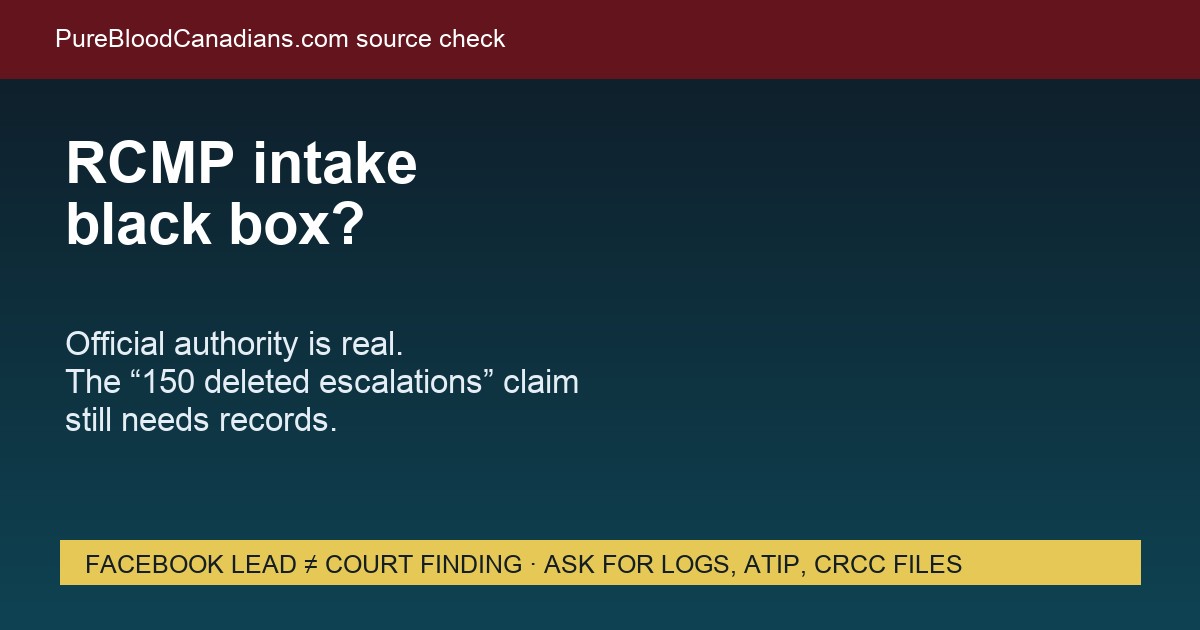
A Facebook post names RCMP Commissioner Michael Duheme and alleges a collapse in federal complaint intake: unread deletions, ignored constitutional escalations and failed routing. The civil-liberties issue is real. The post’s strongest factual claim still needs records.
Bottom line
The official-source part is clear: under section 5 of the RCMP Act, the Commissioner has, under the Minister, “control and management of the Force and all matters connected with the Force.” That makes intake, routing and record-preservation questions legitimate public-accountability questions.
But PBC did not find a court record, CRCC file, ATIP package or audit log proving the Facebook post’s central allegation that nearly 150 constitutional escalations were deleted unread. Until those records are produced, that claim should be treated as an allegation.
What the Facebook post alleges
The post argues that Duheme sits at the apex of federal policing systems and that his office controls operational systems, administrative intake, investigative triggers and records. It alleges that constitutional escalations were deleted unread, federal triggers were ignored and oversight bodies closed matters prematurely.
Those are serious claims. They require evidence: delivery logs, deletion logs, retention rules, CRCC records, RCMP Commissioner responses, ATIP releases or court-filed affidavits.
What official sources confirm
- Commissioner authority: RCMP Act section 5 says the Commissioner has control and management of the Force and all matters connected with it, under the Minister.
- Information/data management: Treasury Board’s Policy on Service and Digital sets government-wide expectations for service, information, data, IT and cyber security management.
- Legal concepts: Criminal Code provisions exist for obstruction of justice and breach of trust by public officer, but PBC found no court finding applying those provisions to this Facebook allegation.
- Oversight structure: RCMP complaints can involve RCMP handling and civilian review through the CRCC framework, but a Facebook post is not the same thing as a CRCC finding.
The real civil-liberties question
For PBC, the important issue is not whether one viral post can prove a system collapse. It cannot. The important issue is whether Canadians have a transparent way to know what happened when a federal policing complaint, constitutional notice or rights-based escalation is sent into an intake system.
If a complaint is received, who logs it? Who decides whether it is routed to Federal Policing, a detachment, the CRCC, legal services or nowhere? How long are emails retained? Are unread deletions possible? Are auto-delete rules used? Can complainants get a tracking number? Can Parliament or the public audit intake failure rates?
What would prove or disprove the claim
- Original escalation emails or submissions, with timestamps and recipient addresses.
- RCMP mail-server logs showing delivery, routing, reading, deletion or auto-deletion.
- ATIP/Privacy Act records showing retention decisions and responsive records.
- CRCC complaint files, review requests and any Commissioner response.
- Federal Court pleadings, affidavits or exhibits if judicial review has been filed.
- Policies governing constitutional complaints, federal policing intake and record preservation.
Without those records, the correct label is: serious allegation, not proven fact.