PBC feature · CRA / benefits / immigration claim · August 17, 2026
CRA “whistleblower” TikTok: child benefits, newcomers and the real math behind the outrage
The TikTok’s real find is not a proved “CRA whistleblower scandal.” The real find is the scale of Canada’s income-tested child-benefit formula when a very low-income family has several eligible children. The fraud and voter-base claims still need records.
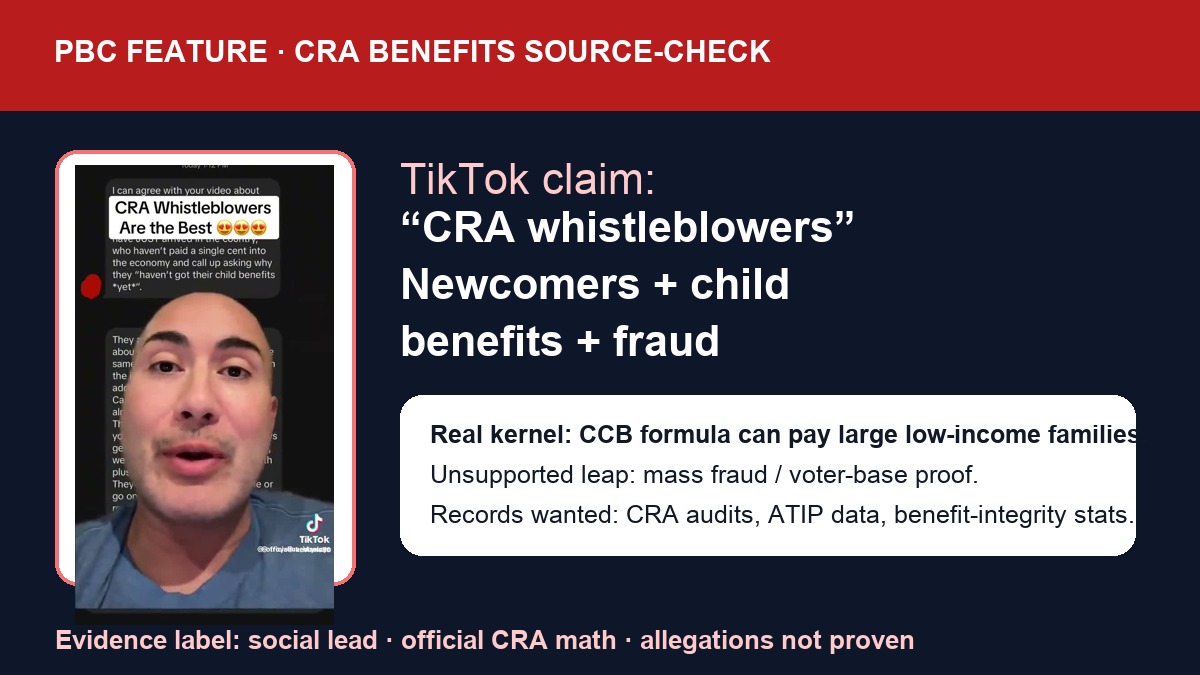
What the TikTok says
The video from @concernedcanadian48 shows a speaker reading an alleged anonymous CRA-worker message. The message claims newcomers call about child benefits soon after arriving, that benefit amounts can reach $3,000/month or $37,000–$40,000/year, and that families may also receive GST/CGEB, CCR, B.C. credits, Quebec family allowance and French-course assistance.
Key line from transcript: “They usually have upwards of four young children, so they almost always get the maximum benefits… $3,000 plus per month plus any additional provincial supplements.”
The speaker then adds broader claims about under-the-table work, social assistance, scamming and political vote-buying. Those claims are treated here as allegations/commentary, not established fact.
The official math
CRA’s 2026–2027 T4114 booklet says the CCB is calculated using the number and ages of eligible children and the family’s 2025 adjusted family net income. It also says both spouses/common-law partners must file tax returns every year, even if they had no income.
| Low-income scenario | CCB only | With B.C. family benefit + CGEB | Interpretation |
|---|---|---|---|
| 4 children under 6 | $32,628/year; $2,719/month | $39,104/year; $3,258.67/month equivalent | Supports the TikTok’s $3,000+/month only when provincial/CGEB are included. |
| 5 children under 6 | $40,785/year; $3,398.75/month | $48,395/year; $4,032.92/month equivalent | Makes the “$37k–$40k just in CCB” claim plausible, but only for a very large young-child family. |
| 4 children age 6–17 | $27,532/year; $2,294.33/month | $34,008/year; $2,834/month equivalent | Below the TikTok’s claimed CCB-only range. |
Who can qualify?
CRA records do not say “anyone who just arrived” automatically receives CCB. The applicant must meet all criteria: live with and care for an eligible child, be resident in Canada for tax purposes, and have a qualifying status. Canadian citizens, permanent residents and protected persons may qualify if the other criteria are met. Temporary residents face a key limit: CRA says they must have lived in Canada throughout the previous 18 months and have a valid permit in the 19th month.
CRA’s T4114 also says a refugee claimant who has not yet received a positive notice of decision is not considered a protected person for CCB.
What is real, stale, and unproven?
| Claim | Evidence label | Finding |
|---|---|---|
| TikTok says an anonymous CRA worker complained about newcomers asking for child benefits soon after arrival. | Confirmed as video claim, not verified whistleblower identity | The TikTok metadata, OCR frames and transcript show this claim stack. PBC could not verify the sender, CRA employment or whether the message is authentic. |
| Newcomer/permanent resident/protected-person families can qualify for CCB if they meet CRA conditions. | Supported by CRA T4114 | CRA says applicants must meet all CCB criteria: live with/care for the child, be resident for tax purposes, and have an eligible status. Protected persons may qualify; refugee claimants without a positive decision are not protected persons for CCB. |
| Temporary residents can receive CCB immediately on arrival. | Mostly false / missing condition | CRA T4114 says a temporary resident must have lived in Canada throughout the previous 18 months and have a valid permit in month 19; otherwise the application only registers for CGEB/other CRA programs until conditions are met. |
| CCB is based on adjusted family net income, so very-low-income families with several children can receive large payments. | Supported | For July 2026–June 2027, CRA lists $8,157/year per eligible child under 6 and $6,883/year for ages 6–17, reduced when AFNI exceeds $38,237. |
| $3,000+ per month / $37k–$40k per year is possible. | Plausible only for a large low-income family; context required | Four children under 6 would be $32,628/year in CCB alone; adding B.C. family benefit and CGEB would be about $39,104/year. Five children under 6 would exceed $40k in CCB alone. This does not prove fraud. |
| Canada Carbon Rebate is part of a current 2026 benefit stack. | Stale for current payments | CRA says the federal fuel charge and individual CCR stopped March 15, 2025, with no quarterly CCR payments after April 2025. |
| B.C. climate action tax credit is current ongoing support. | Prior-year only | B.C. describes the climate action tax credit in past tense and says payments were for prior benefit years, with July 2024–June 2025 as the last listed period. |
| Quebec pays immigrants to take French classes. | Partly supported with eligibility limits | Quebec says eligible immigrants in full-time French courses could receive $230/week, plus possible childcare/transportation help, with exclusions including refugee claimants for some assistance. |
| The video’s under-the-table work, mass scamming, and Liberal voter-base claims are proven. | Unsupported in this source trail | The TikTok presents allegation and political commentary. PBC found no official record in this pass proving the anonymous claims as a broad pattern. |
| CRA has review/fraud controls. | Supported | CRA says it may request documents to verify benefits and credits, reviews marital status, primary care and residency, and has a route to report false claims. |
The parts the TikTok gets stale or wrong
- CCR: CRA says the individual Canada Carbon Rebate stopped after the April 2025 payment. Listing CCR as a current 2026 quarterly stack is stale.
- B.C. climate action tax credit: B.C. now frames it as a prior-year credit; it was tied to earlier quarterly periods.
- “Just arrived” temporary residents: the CCB has an 18-month temporary-resident condition.
- Fraud claims: under-the-table work and mass scamming require audit, court, CRA enforcement or ATIP records.
The parts that are real public-policy questions
The social-video rhetoric is harsh, but the benefit-design question is legitimate: should a family benefit be mainly child/need-based, or should it give more weight to tax paid into the system? Canada’s current CCB design is income-tested and child-count-based. That means low-income families receive more, regardless of whether their low income comes from recent arrival, unemployment, low wages, caregiving, disability, or other circumstances.
For PBC, the records still wanted are specific: CCB payments by immigration-status category; CRA benefit-validation review counts by benefit type; overpayment/fraud recovery numbers; ATIP records on newcomer benefit processing; and Parliamentary Budget Officer-style cost breakdowns for family benefits by residency/status category.
What PBC is not saying
- PBC is not identifying the alleged CRA source.
- PBC is not saying immigrants or refugees as a class are committing fraud.
- PBC is not saying CCB payments are illegal when CRA eligibility criteria are met.
- PBC is not treating the voter-base claim as proven.
Sources saved
- Source note
- Claim table
- Benefit-scenario arithmetic
- TikTok transcript
- CRA T4114 — Canada Child Benefit 2026–2027
- CRA RC4210 — Canada Groceries and Essentials Benefit 2026–2027
- CRA RC66SCH — status and income information form
- CRA — Canada Carbon Rebate closed
- B.C. climate action tax credit prior-years page
- Quebec French-course financial assistance