PBC Health / COVID / Cancer · Source-check · August 15, 2026
Jimmy Dore / Dalgleish cancer claim: does the video prove COVID, or the vaccine, is the cause?
The YouTube interview is real. The important correction is that the video’s claim is mainly about COVID vaccination / mRNA / spike, not proof that ordinary COVID infection alone is the direct cause of cancer.
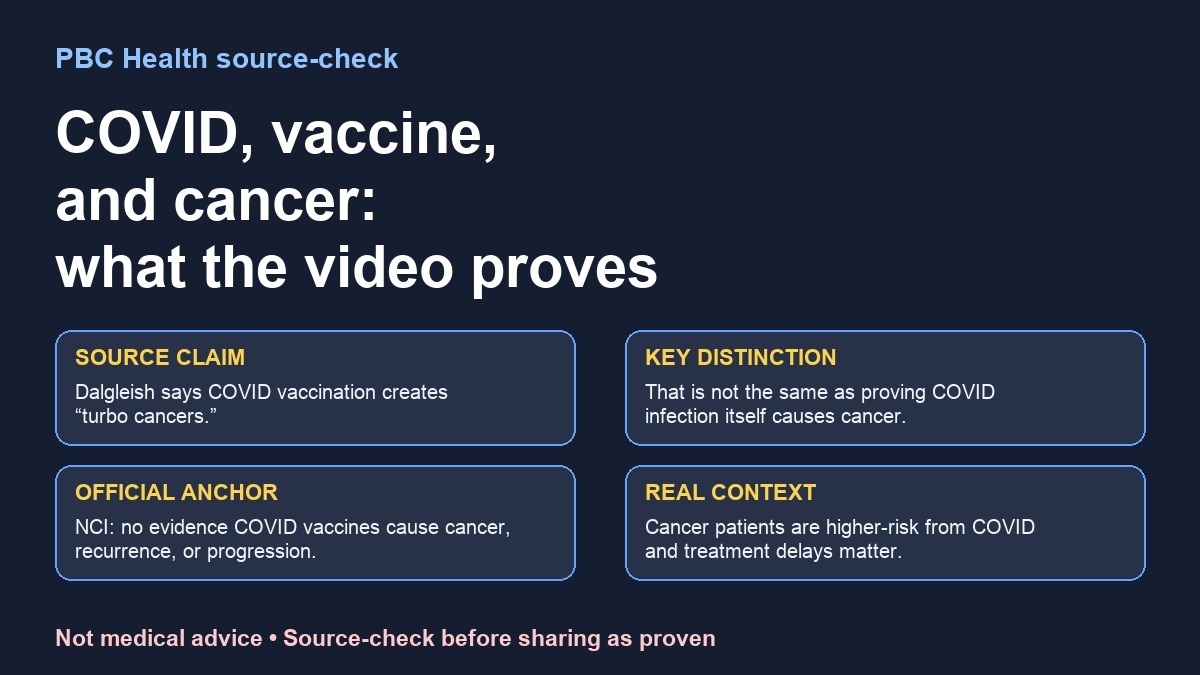
Short answer
What the video proves: Angus Dalgleish and Jimmy Dore discussed and promoted a “COVID vaccine causes turbo cancer” claim. The saved transcript captures lines such as “COVID-19 vaccine induces cancer” and alleged mechanisms involving mRNA/spike/immune pathways.
What it does not prove: It does not prove that COVID infection itself is the direct cause of cancer, nor does it establish a verified clinical causal link between COVID vaccines and cancer.
What is real: cancer patients are vulnerable to severe COVID; COVID infection and long COVID can disrupt treatment and outcomes; pandemic delays disrupted cancer screening/diagnosis/treatment; and mechanistic papers discuss possible SARS-CoV-2/cancer pathways. Those are evidence lanes, not a simple proof statement.
Claim table
| Claim | Evidence label | Finding |
|---|---|---|
| The YouTube video exists and is the Jimmy Dore / Angus Dalgleish interview. | Confirmed source claim | YouTube metadata/title/description and saved auto-subtitles confirm the video. |
| The video proves “COVID itself” is the direct cause of cancer. | Not established / unclear framing | The title, description and transcript mostly frame the claim as COVID vaccination/mRNA/spike, not ordinary SARS-CoV-2 infection alone. |
| Dalgleish claims COVID vaccination creates “turbo cancers.” | Confirmed source claim / expert opinion | Transcript says “COVID-19 vaccine induces cancer” and discusses alleged mechanisms. That proves he made the claim, not that the claim is clinically proven. |
| COVID vaccines have been shown to cause cancer, recurrence or progression. | Not established by official oncology guidance | NCI says there is no evidence COVID-19 vaccines cause cancer, lead to recurrence, or lead to disease progression, and that they do not change DNA. |
| COVID infection can be harmful for cancer patients. | Established evidence / official guidance | NCI and oncology literature state people with cancer are at higher risk of severe COVID outcomes and treatment disruption. |
| SARS-CoV-2 infection may have theoretical cancer-related mechanisms. | Hypothesis / mechanistic review | Reviews discuss inflammation, immune dysregulation and possible oncogenic pathways; this is not the same as population-level proof that COVID infection directly causes cancer. |
| Pandemic disruptions caused cancer screening/diagnosis/treatment delays. | Supported evidence | Reviews and studies document pandemic-related delays and disruptions in cancer services; this can worsen stage at diagnosis without proving viral causation. |
| Cancer patients should change cancer treatment or vaccination decisions based on this video. | Unsafe unsupported medical advice | No personal medical instruction is given; decisions require oncology/infectious-disease clinician review. |
Key distinction: COVID infection vs COVID vaccine vs pandemic effects
- COVID infection: supported as dangerous for many cancer patients and relevant to inflammation/immune-response research; not established here as a proven direct cancer cause.
- COVID vaccine: Dalgleish claims it causes or accelerates cancer; NCI says there is no evidence COVID-19 vaccines cause cancer, recurrence or progression, and that they do not change DNA.
- Pandemic disruption: supported as a real cancer-care problem because screening, diagnosis and treatment were delayed in many settings.
- Anecdotes/case reports: hypothesis-generating, not proof of causation.
Source package
- Source note
- Claim table
- YouTube auto-transcript
- YouTube metadata JSON
- YouTube browser capture
- NCI: COVID vaccines and people with cancer
- FactCheck.org 2024 cancer-risk source
- FactCheck.org turbo-cancer source
Evidence label: confirmed source claim; broad causal claim not established; COVID infection/cancer pathways remain a research question; pandemic cancer-care disruption is real.