Liana K. case: psychiatric confinement, failed removal and an old ruling recirculated as “breaking”
PBC — Outside Canada | First published 22 July 2026; updated 15 November 2026. Follow-up research prepared 12 November; sources refreshed 15 November.
Verdict: The April confinement order is real; “breaking” November framing is misleading. Both sides filed appeals in May. A later appellate outcome has not been confirmed in this review.
A real court outcome—but not a new ruling
A Facebook post by David J Harris Jr. dated 12 November presents the Liana K. case as “BREAKING,” saying the man responsible for her death will serve no prison time. The central outcome is supported, but the ruling being described dates to 29 April 2026, not November. PBC already covered the case in July. [1, 2, 3]
According to German public broadcaster NDR, the Göttingen Regional Court found that Mohammed A., an Iraqi man aged 31 at the time of the proceedings, pushed 16-year-old Ukrainian refugee Liana K. against a passing freight train at Friedland station on 11 August 2025. She suffered fatal head injuries. DNA evidence on her clothing, particularly her back, was central to the court’s reconstruction. There were no eyewitnesses to the push and no camera footage of it. [2, 3]
The court found him criminally incapable at the time of the act because of paranoid schizophrenia and ordered psychiatric-hospital confinement. NDR’s follow-up, citing the state social ministry, described a highly secured forensic psychiatric facility—not freedom or voluntary outpatient care. [2, 3]
No prison sentence does not mean release
German law separates criminal responsibility from whether someone committed an unlawful act and poses a continuing danger. Section 20 of the Criminal Code addresses an inability, because of specified mental disorders, to understand the wrongfulness of an act or act in accordance with that understanding. Section 63 provides for psychiatric confinement when its legal requirements, including the prospect of serious unlawful acts and danger to the public, are met. [5, 6]
The order has no fixed sentence end date, but it is subject to judicial review. Section 67e generally requires review within one year for psychiatric-hospital confinement. That is a review deadline, not an automatic release date. “Indefinite” should not be rewritten as either “released” or “guaranteed to remain confined for life.” [7]
NDR reported that the court classified the act as Totschlag, rather than Mord, in the German legal distinction. It reported that the illness prevented conscious exploitation of Liana’s unsuspecting state. This was a Sicherungsverfahren concerning confinement, not an ordinary criminal conviction followed by a prison sentence. [3]
Both sides challenged the ruling
On 7 May 2026, NDR reported that both the defence and the victim’s mother’s legal representatives had filed appeals on points of law (Revision). The defence disputed the evidential basis; the mother’s representatives sought a finding of guilt through ordinary criminal proceedings. [4]
No later authoritative appellate outcome was established in the November 15 source refresh. This is a limit of this review, not confirmation that an appeal remains pending. The April disposition should therefore be reported with its appeal history, not presented as a newly issued, conclusively final decision that he can never receive a prison sentence.
The removal failure deserves scrutiny
The removal issue is not invented. The proposed transfer was to Lithuania under the European asylum-responsibility system, not simply a documented plan to deport him directly to Iraq. [2, 3]
More importantly, official Lower Saxony parliamentary minutes record a specific acknowledged failure. On 13 November 2025, Interior Minister Daniela Behrens said the state reception authority had sought deportation detention, the Hanover local court had refused it, and the authority had not appealed. She said, in hindsight, an appeal should have been filed. She also explicitly said nobody could now establish whether it would have been decided promptly or succeeded. [8]
In the same committee hearing, Behrens defended the police response and rejected allegations of police failure or concealment. Her acknowledgement about the unfiled detention appeal should not be expanded into an admission of a deliberate cover-up. [8]
That is stronger evidence than a general slogan about government failure: it identifies an actual decision and the minister’s concession. It does not, by itself, prove that a successful removal or prevention of this particular killing was guaranteed, nor establish judicial misconduct.
A further parliamentary question from CDU legislators André Bock and Carina Hermann, submitted on 28 October 2026 and distributed on 5 November, asks what reforms and administrative changes have actually been implemented. This is a newly relevant accountability document—but it is a legislators’ question, not a completed investigation or government answer. [9]
What the record establishes
- Dates the psychiatric-confinement ruling accurately: 29 April 2026.
- Separates a prison sentence from secure, potentially long-term psychiatric confinement.
- Adds the confirmed May appeals, without guessing their present outcome.
- Adds the minister’s recorded acknowledgement that the detention refusal should have been appealed, alongside her uncertainty about the counterfactual result.
- Flags the October parliamentary question as a question requiring answers, not proof that every allegation in its framing has been adjudicated.
Liana’s death warrants serious scrutiny of removal procedures, risk assessment and institutional coordination. Accurate dates and legal terminology strengthen that scrutiny. This individual case does not establish collective responsibility among refugees, Iraqis or people with schizophrenia.
Sources
- Supplied Facebook post, resolved post ID
2077967413901789. Caption and static graphic captured; graphic contains “BREAKING,” not a court document. - NDR, 29 April 2026 — court outcome.
- NDR, 1 May 2026 — findings, secure placement and legal classification.
- NDR, 7 May 2026 — both sides file Revision.
- German Criminal Code §20.
- German Criminal Code §63.
- German Criminal Code §67e.
- Lower Saxony Interior and Sport Committee, 13 November 2025, pp. 7 and 33.
- Lower Saxony parliamentary question 19/12005.
Research limits: Full written court reasons and a later appellate disposition were not recovered. The court findings are attributed to contemporaneous NDR reporting; statutes and parliamentary records were retrieved directly. The exact dramatic account of sounds heard by the grandfather is not necessary to this update and has not been independently established here. No treatment-cost figure was verified. Judicial decision-makers were not named in the accessible sources reviewed; no identity has been inferred from a court roster.
Claim-by-claim
| Claim | Assessment |
|---|---|
| Ruling date | 29 April 2026, not November; attributed to NDR reporting. |
| Confinement | Secure psychiatric placement, subject to judicial review; not release or a guaranteed lifetime term. |
| Appeals | Both sides filed Revision in May; later disposition unconfirmed in this review. |
| Removal failure | Minister acknowledged no appeal against detention refusal; success and prevention were not guaranteed. |
| Collective blame | The individual case establishes no collective responsibility. |
Source package
Read the source note · Claim table. Original source links are listed above.
Earlier source review: July 22, 2026
The earlier source trail is retained below. The November update above supplies the precise ruling date, appeal history and legal qualifications; it takes precedence on those points.
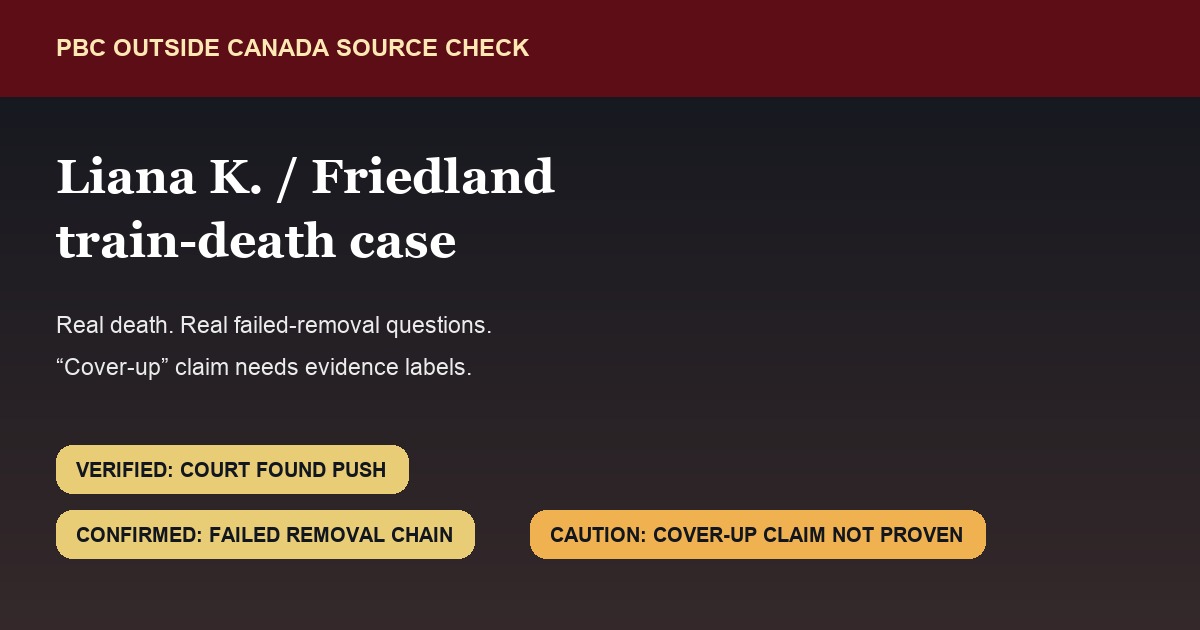
A viral post says 16-year-old Ukrainian refugee Liana was killed in Germany after authorities first treated her rail death as suicide, and that the truth emerged only after political pressure. The reliable record is grave enough without exaggeration: a German court found that a 31-year-old Iraqi asylum seeker pushed Liana K. against a passing freight train; deportation/removal steps had failed; and the court ordered psychiatric confinement instead of prison because of legal-incapacity findings.
Short version: the death, the train-track push finding, the Iraqi suspect, the failed removal history, DNA link and psychiatric placement are supported. The word “cover-up” is not a court finding in the sources reviewed; the better-supported claim is that authorities initially treated the case as suicide or accident, did not immediately publicize the murder inquiry, and later faced serious political and family criticism.

What is verified
| Claim | Status |
|---|---|
| Liana K. was a 16-year-old Ukrainian refugee who died at Friedland station in Lower Saxony. | Supported by NDR, NZZ, HNA, Kyiv Independent and other reporting. |
| She was pushed/struck against a train by a 31-year-old Iraqi asylum seeker / rejected asylum applicant. | Supported. NDR says the Göttingen court was convinced the man pushed the 16-year-old against a passing freight train. |
| Police first treated the death as suicide or accident. | Supported with nuance. NDR quotes the state police president saying there was initially no founded suspicion of a crime and suicide/accident was assumed, but doubts arose very soon and a murder commission was formed two days later. |
| DNA linked the suspect to Liana K. | Supported. NDR reports DNA traces of the 31-year-old on the dead 16-year-old’s clothing; NZZ refers to traces on her shoulder. |
| The suspect was required to leave Germany / deportation or transfer had failed. | Supported. NDR reports he was subject to removal and could have been deported from March 2025 according to the Landtag account; NZZ reports multiple failed removal/transfer steps. |
| The court sent him to psychiatric confinement instead of prison. | Supported. NDR reports the Landgericht Göttingen ordered psychiatric-hospital placement without a fixed end date, subject to review (see the update above for appeals) after paranoid-schizophrenia/legal-incapacity findings; NDR also noted the decision was not yet final in its April 2026 report. NDR subsequently reported appeals by both sides on May 7; a later outcome has not been confirmed here. |
| Authorities deliberately covered up a murder. | Not proven by the source trail. There are serious public-accountability questions, but “cover-up” is an allegation/political framing unless stronger evidence shows deliberate concealment. |
| The exact claim that he sexually harassed/chased her before the killing. | Not firmly established in the best sources found. Some reports say the suspect had harassed people before and that Liana was on the phone with her grandfather; PBC is not treating the exact sexual-harassment/chase wording as verified. |
Timeline from the source trail
August 2022: NDR says the Iraqi man entered Germany, made an asylum request, and was later connected to a Dublin/Lithuania transfer issue.
December 2022 to 2025: NDR and NZZ report asylum/removal decisions and legal/administrative failures that left him in Germany. NDR says he could have been deported from March 2025; NZZ describes multiple failed removal steps.
11 August 2025: Liana K. died at Friedland station. She had fled Ukraine with her family. NZZ reports she was on the phone with her grandfather in Ukraine shortly before or during the incident.
13 August 2025: NDR says a murder commission called “Grenzfall” was formed two days after the death.
27–29 August 2025: NDR reports DNA evidence on Liana K.’s clothing and then temporary psychiatric placement of the suspect.
September–November 2025: NDR reports CDU and AfD pressure/questions in the Lower Saxony Landtag and that Interior Minister Daniela Behrens acknowledged gaps in the deportation system.
January–April 2026: NDR reports prosecutors treated the suspect as likely legally incapable due to diagnosed schizophrenia, sought a Sicherungsverfahren rather than a normal criminal trial, and the Göttingen court ordered psychiatric-hospital placement.
Was it a “cover-up”?
Cover-up claim: not proven as a legal finding from the source trail reviewed.
Accountability concern: supported. Authorities initially worked from suicide/accident, did not immediately publicize the murder commission, and later had to explain why an out-of-status man with prior incidents and deportation steps was still in the country.
Family/political pressure: supported. NDR reports CDU questions, an AfD attempt to create a parliamentary inquiry, and pressure over police/justice/interior handling. NZZ reports the mother sought help and the case became politically public before the prosecution announced urgent suspicion.
Bottom line: calling it an “attempted cover-up” is stronger than the proof available here. Calling it a serious failure of early classification, transparency and removal enforcement is well supported.
Why Canadians may care
This case belongs in Outside Canada because it touches issues Canadians also debate: refugee protection, removal orders, mental-health risk, criminal responsibility, youth safety, public trust in police communication, and how quickly a system corrects a wrong initial assumption.
The lesson is not collective blame. One case does not indict every refugee, migrant, Iraqi, doctor, police officer, judge or government worker. The legitimate public-interest question is narrower and sharper: when a person is legally removable, repeatedly in contact with authorities and clinically unstable, what safeguards failed before an innocent 16-year-old died?
Source trail
- NDR chronology of the Liana K. case
- NDR: deportation detention had been rejected / Landtag briefing
- Tagesspiegel: psychiatric placement and failed deportation
- NZZ: psychiatric placement instead of prison
- HNA local/family reporting
- Kyiv Independent: Ukrainian refugee girl killed in Germany
- PBC source note
- Source extracts JSON
Bottom line
The viral post has a large factual core: Liana K. was killed; the court found an Iraqi asylum seeker pushed her against a train; deportation steps failed; and he was sent to psychiatric confinement rather than prison because the process treated him as legally incapable. But the most responsible wording is not “cover-up proven.” It is: initial suicide/accident framing, delayed public clarity, failed deportation enforcement and psychiatric-law outcome — all of which deserve public scrutiny.