Homeschooling in Canada: growth, choice and what families need to know
More Canadian families are educating their children at home than before COVID-19. The increase is real—but the national numbers tell a more useful story than a viral claim of a school-system exodus.
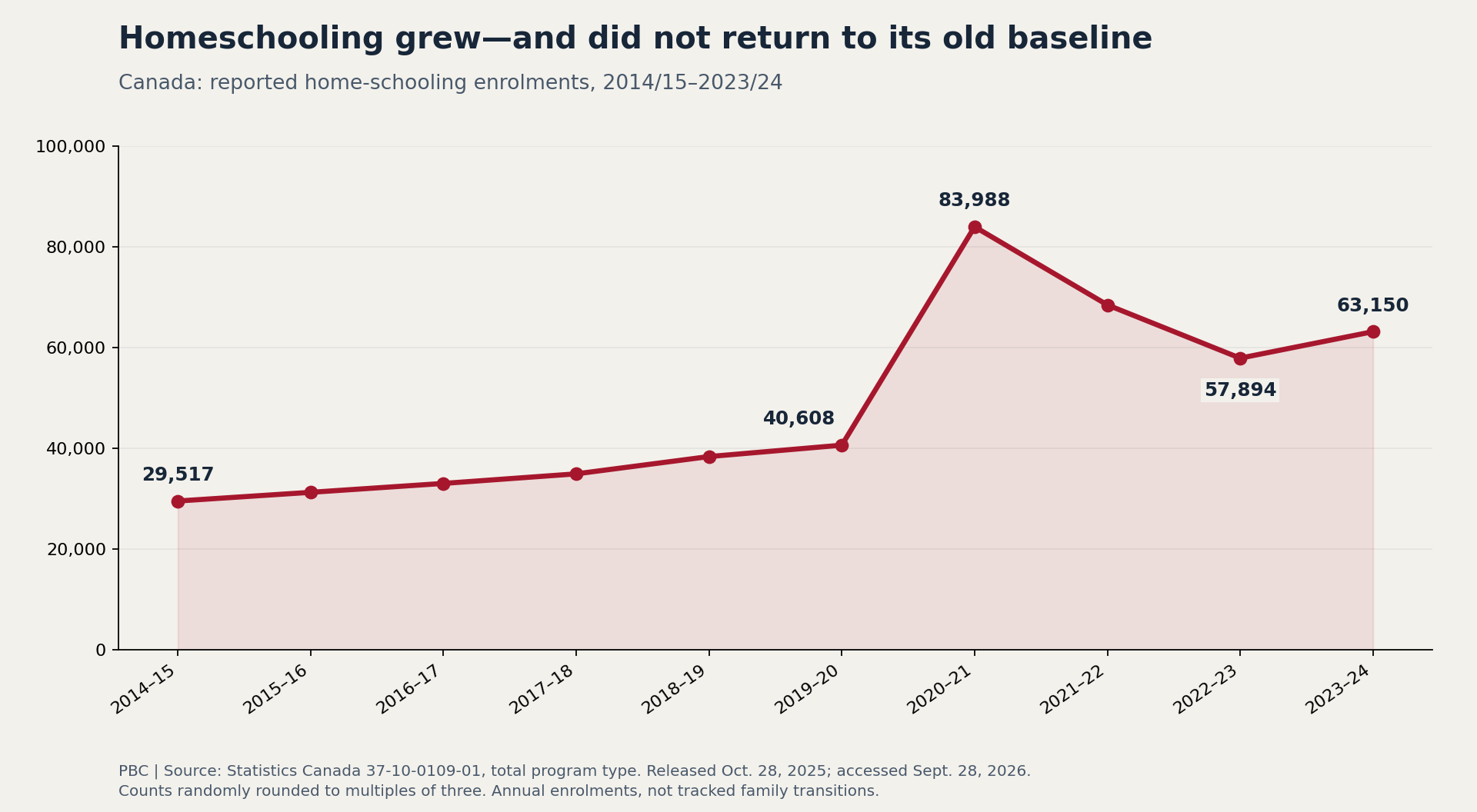
The short version: Canada reported 63,150 homeschooled enrolments in 2023/24—55.5% above 2019/20, but 24.8% below the pandemic peak. The latest year rose 9.1%. Homeschooling remained about 1% of all recorded elementary and secondary enrolments.
- Homeschooling grew before the pandemic, jumped during school closures, then fell back—but not to its old baseline.
- Parent-led homeschooling is not the same as a child attending a public or independent school online.
- Families’ reasons differ. Flexibility, learning needs, safety and values deserve serious discussion; enrolment totals cannot tell us which motive dominates.
- Good choices require a realistic plan for teaching, income, friendships, specialist support and future qualifications.
A bigger movement, not a majority movement
The latest comparable national figures available at our September 28, 2026 check are for 2023/24, not the current school year. Statistics Canada’s school-type table, released October 28, 2025, records 29,517 home-schooled enrolments in 2014/15, 40,608 in 2019/20 and 63,150 in 2023/24. That is more than double the 2014/15 level. The extraordinary 2020/21 peak was 83,988; enrolment then declined for two years before rebounding in 2023/24.
On a narrow screen, swipe the table horizontally to see every column.
| School year | Home-schooled enrolments |
|---|---|
| 2014/2015 | 29,517 |
| 2018/2019 | 38,346 |
| 2019/2020 | 40,608 |
| 2020/2021 | 83,988 |
| 2021/2022 | 68,466 |
| 2022/2023 | 57,894 |
| 2023/2024 | 63,150 |
The distinction between a level and a growth rate matters. A large percentage increase from a small base can be important to families and education policy without meaning that most children have left schools. It is also possible for public-school enrolment to rise in absolute terms while its share of total enrolment falls.
For perspective, homeschooling accounted for 1.05% of all recorded elementary/secondary enrolments in 2023/24. Using only regular youth programs produces a slightly different share, 1.11%. The same Statistics Canada release says public-school enrolment grew 2.3% nationally that year to about 5.5 million. That does not support a simultaneous national collapse in public-school attendance.
These are annual administrative counts, not a study following the same families. A post-pandemic total above the old baseline does not establish how many pandemic newcomers stayed, how many returned to school or how many new families replaced them. Nor does it prove that the elevated level is permanent.
The provinces tell different stories
Alberta leads the provinces in both reported count, at 24,279, and share of all recorded school enrolments, at 3.09%. Manitoba and Saskatchewan also have comparatively high shares. Ontario has 13,134, while B.C. has 4,341—76.9% above its 2019/20 count of 2,454. Yukon has a higher percentage than any province, but on a much smaller population base. The Northwest Territories is below its 2019/20 baseline, demonstrating that growth has not been uniform.
On a narrow screen, swipe the table horizontally to see every column.
| Province / territory | Enrolments | Share of all recorded school enrolments | Change since 2019/20 |
|---|---|---|---|
| Newfoundland and Labrador | 222 | 0.34% | +45.1% |
| Prince Edward Island | 282 | 1.25% | +44.6% |
| Nova Scotia | 1,773 | 1.29% | +55.9% |
| New Brunswick | 1,617 | 1.47% | +71.7% |
| Quebec | 7,350 | 0.50% | +70.6% |
| Ontario | 13,134 | 0.58% | +32.8% |
| Manitoba | 5,109 | 2.38% | +38.5% |
| Saskatchewan | 4,587 | 2.25% | +65.1% |
| Alberta | 24,279 | 3.09% | +64.8% |
| British Columbia | 4,341 | 0.62% | +76.9% |
| Yukon | 324 | 5.16% | +74.2% |
| Northwest Territories | 129 | 1.53% | -15.7% |
| Nunavut | Not separately reported | — | — |
These figures need a definition attached. The data count reported home-schooled enrolments using the table’s total-program category; they are not a census of every child who learns at a kitchen table. Registration practices, program classifications and reporting coverage differ. Missing or unregistered children cannot responsibly be converted into an invented “true” national total.
What the Ontario Reel gets right—and what remains unverified
The supplied Instagram Reel shared by Keesha Carty includes a commentator reading a Google AI Overview. It says nearly 60% of Ontario school boards face year-over-year enrolment declines and homeschooling rose 176% over an unspecified multiyear period. We downloaded the clip, inspected sampled frames and generated an automated audio transcript. The Google summary is visible; the underlying dated dataset is not.
Using the same Statistics Canada series, Ontario rose from 9,891 in 2019/20 to 13,134 in 2023/24: an increase of 32.8%. That is substantial, but it is not 176% over that interval. An older interval, 2006/07–2019/20, does produce approximately 176%; this arithmetic match does not establish where the Reel’s figure came from. Without a starting and ending year, “up 176%” is not a usable description of the current trend.
The “nearly 60% of boards” claim does have an attributable reporting trail. The Toronto Star reported on September 5, 2026, in an article updated September 25, that Ontario’s ministry described an enrolment inflection point in 2025–26 and declines in nearly 60% of boards. We have not independently reproduced that percentage from a board-by-board primary dataset. A May 13, 2026 ministry funding memo separately projects about 13,000 fewer students province-wide in 2026–27.
Those are genuine Ontario pressures, but they concern a later period than the national 2023–24 data. A percentage of boards with declines is not the percentage of students leaving school, and neither source establishes that homeschooling caused the declines. The Star also identifies immigration changes, fewer births and families moving. Smaller and larger boards do not carry equal enrolment weight.
Ontario can have underused schools and overcrowded schools at the same time. The Financial Accountability Office’s December 2024 report, using 2023–24 information, identified 858 schools below 60% capacity and 1,458 above full capacity. Those are building-utilization measures, not the Reel’s board-decline statistic. They illustrate why demographics, migration within the province and school locations must be considered alongside parental choice.
The defensible conclusion is that home education has expanded substantially. A single AI-generated paragraph is not enough to establish a current, nationwide collapse of public education.
Why families choose home education
There is no single homeschooling family. Some deliberately seek an alternative philosophy or religious education. Others want more time together, flexible schedules or a better fit for a child who learns quickly in one subject and needs support in another. Some are responding to bullying, anxiety, disability-related barriers or a breakdown in trust with a particular school. These are different situations and should not be flattened into one political explanation.
CBC’s 2022 interviews with families continuing after the initial pandemic disruption describe flexible pacing, family time, learning beyond a classroom and rural travel considerations. They also describe the work involved and difficulties managing different children’s interests. Those are illustrative experiences, not a representative survey of Canadian motives. Earlier Quebec research involving 203 families, published in 2003, likewise found multidimensional reasons—not one dominant religious, philosophical or anti-state explanation in that sample. Neither source measures today’s national distribution of motives.
Choice can mean opportunity—or a lack of workable options
A family may welcome the chance to build learning around books, outdoor activities, practical projects, culture and community. Another may feel pushed into home education because the school environment has become unsafe or cannot accommodate their child. Both experiences matter.
A 2025 study in Autism Research examined accounts from 412 Ontario caregivers. Parents described bullying, inadequate staff support and withdrawing children to home education for safety and well-being. One account also described social isolation and problems with inflexible online learning after leaving school. Crucially, the survey was conducted in 2018, not after COVID. It documents pressures within a selected caregiver sample, not the prevalence of those experiences among all homeschoolers or proof that home education solves every difficulty.
That distinction matters for policy. Respecting a parent’s decision to teach at home does not excuse a school system from providing safe, accessible education to families who want it. Equally, improving schools should not require treating all home educators as a problem to be eliminated.
Does homeschooling produce better results?
There is encouraging Canadian evidence, but not a universal verdict. A 2011 Canadian study by Sandra Martin-Chang and colleagues directly tested 74 children aged five to ten in Nova Scotia and New Brunswick: 37 home-educated and 37 public-school students. The structured-homeschool subgroup scored higher than the school comparison group; the small unstructured subgroup scored lower. The paper makes clear that families volunteered. This was neither random assignment nor a representative national sample, and early test results do not establish lifelong effects.
Similarly, Fifteen Years Later: Home-Educated Canadian Adults (2009) reported positive education and life outcomes in 226 respondents from 128 families, but the authors explicitly said the findings could not be generalized to everyone ever home educated in Canada. The report was funded by the Canadian Centre for Home Education. Such studies show successful pathways are possible; they do not prove that homeschooling itself caused every reported advantage.
It is reasonable to ask about literacy, numeracy, scientific understanding, well-being, friendships and opportunities after secondary school. It is not reasonable to promise that a change of setting alone guarantees success. Home education includes highly structured lessons, mixed approaches and more child-led learning; the quality of support and the child’s needs matter.
For an individual family, the useful test is practical: Is the child learning? Are gaps being noticed and addressed? Is the child safe and connected to others? Can the arrangement be sustained? Independent feedback, a portfolio of work and a willingness to change course are more useful than a contest over which group of parents cares more.
Know which kind of “school at home” you are choosing
- Parent-led homeschooling: the parent directs the educational program, within provincial or territorial requirements.
- School-run online learning: the child is enrolled in a school, with its teachers, curriculum and assessment rules, even if much of the work happens at home.
- Co-ops, learning pods and microschools: these labels do not settle legal status. Ask who is responsible for instruction, whether the organization is a school, how it is regulated and whether any advertised credits are recognized.
During COVID closures, millions of families experienced some form of schoolwork at home. That experience should not be counted as millions of registered homeschoolers.
The rules: four provinces, four important distinctions
This is a starting-point guide, not individual legal advice. Read the current official instructions before withdrawing a child or buying a program. Requirements and funding can change.
British Columbia: registration is different from enrolment
Under the current B.C. policy, parents must register their homeschooled children with an eligible school by September 30 each year. Parents provide and supervise the program; registered homeschooling is not supervised by a B.C.-certified teacher and need not follow provincial standards. Public registering schools must offer free assessment services and loans of specified educational resources; families may decline them.
Homeschooling alone does not confer the Dogwood diploma. Eligible Grades 10–12 learners can take online-learning courses for graduation credit while retaining registered status. School-run online learning is a different arrangement with certified educators and provincial standards. Registration grants paid to schools are not a direct parental allowance.
Alberta: two routes, different support and funding
Alberta offers supervised home education and notification-only home education. In the supervised route, parents notify a willing school authority annually, and certificated teachers conduct at least two formal evaluations each school year. The notification-only route requires annual notice to the minister and appropriate learning outcomes, but no supervising authority and no Alberta Education funding.
For funded supervised programs, notification and acceptance must occur before September 30; the province says acceptance after September 29 is ineligible for that year’s funding. Its 2026/27 form specifies a maximum parental portion of C$928.03 for Grades 1–12, subject to its eligible-expense and receipt rules. This is educational-resource support, not pay for a parent’s time or a universal benefit. Families seeking recognized high-school credits should plan with the supervising authority using the official handbook.
Ontario: written notification and satisfactory instruction
Policy/Program Memorandum 131 says parents should notify the board in writing. Continuing homeschoolers should renew notice annually before September 1 to the board in whose jurisdiction the child last attended school. Normally the board should accept notice as evidence of satisfactory instruction and should not investigate, though reasonable grounds for concern can trigger an investigation. The policy recognizes that home education need not replicate Ontario’s curriculum or classroom methods. Notification does not award an Ontario secondary diploma; plan credit and admission routes separately.
Quebec: a learning project and continuing oversight
Quebec’s current process requires annual notice no later than July 1, or within 10 days of the last school attendance for a midyear withdrawal. The learning project must be submitted and started by September 30, or within 30 days of the last attendance. Families submit reports, participate with the child in a monitoring meeting and arrange evaluation, including applicable ministerial examinations. Diploma certification rules are the same as for school-attending children.
Elsewhere, start with the official pages for Manitoba, Saskatchewan, New Brunswick, Nova Scotia, Prince Edward Island, Newfoundland and Labrador and Yukon. We did not complete a current rules audit for the Northwest Territories or Nunavut; confirm requirements directly with their education departments.
A practical checklist before making the move
- Start with the child, not the argument. Write down the actual problem to solve and ask the child what is working, what is not and what they would miss. Consider accommodations, another school or school-run online learning alongside home education.
- Make a full household budget. Include reduced paid work, preparation time, books, subscriptions, equipment, tutors, transport, outings and respite. “No tuition” does not mean “no cost.” Do not assume a grant, tax break or reimbursement without checking eligibility in your province.
- Build a learning plan. Set realistic literacy, numeracy and other subject goals; decide how you will assess progress and where outside expertise is needed. Online content and AI tools can help with preparation, but their answers still need checking.
- Plan friendships deliberately. Co-ops, sports, libraries, volunteering and community classes can provide regular contact. Check cost, travel, age fit, supervision and accessibility. Neither a school seat nor a homeschool label guarantees a satisfying social life.
- Protect specialist support. Before withdrawing, get written answers about therapies, disability services, assessments and access to school resources. Do not assume supports transfer automatically.
- Work backwards from the next step. For teenagers, contact prospective schools, colleges, universities or apprenticeship programs directly. Ask about recognized credits, prerequisites, portfolios, examinations and admission routes. A purchased curriculum certificate is not automatically a provincial diploma.
- Keep records and a return route. Save notices, plans, work samples and assessments; learn the re-entry and credit-assessment process. Set a review date with the child. Returning to school, or combining routes where permitted, is not a failure.
For one concrete example, UBC’s Vancouver academic calendar says homeschooled applicants may be eligible, are considered individually and may be expected to present a recognized academic secondary credential. It encourages contact with a program advisor before applying. That is a pathway—not a promise of admission or a waiver of prerequisites.
What governments and school boards should learn
Home education is a legitimate part of the education landscape, and its growth deserves more than dismissal or celebration by slogan. Governments should publish consistent, timely enrolment data, clearly distinguish home education from online enrolment and make obligations easy to understand.
School boards should listen to families who leave: was the issue safety, inadequate support, academic fit, values, scheduling or something else? Voluntary, carefully designed surveys would be more informative than inferring motives from totals. Public schools should respond to preventable problems, while home-educating families should have clear information about resource access and future pathways.
PBC’s view: parental choice and educational responsibility belong together. Canada can respect families who educate at home while expecting meaningful learning, child well-being and access to opportunities—and while insisting that publicly funded schools remain a workable choice.
The video that prompted this feature
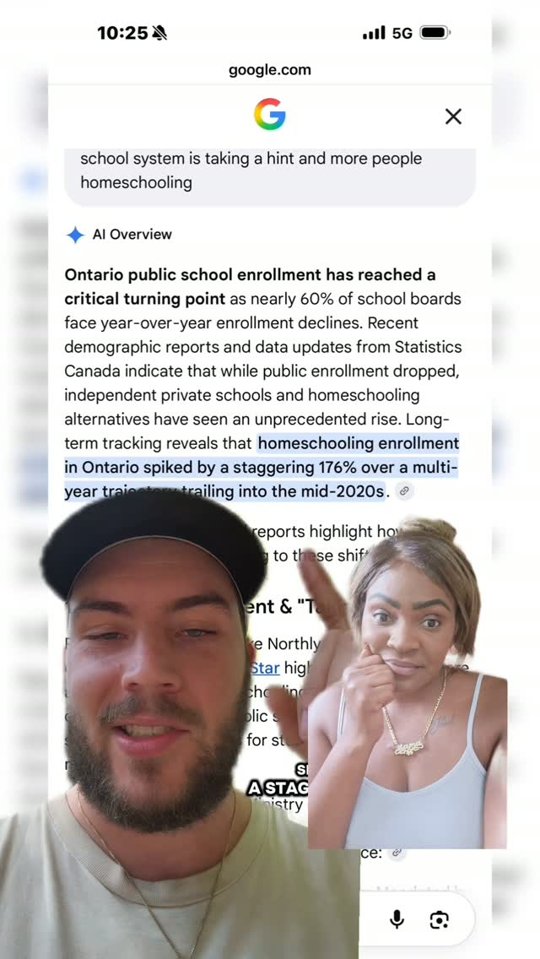
Keesha Carty’s Instagram share, dated September 9, 2026 in downloaded metadata; approximately 91 seconds. The presenter’s commentary and the uploader’s caption are not Statistics Canada findings. Watch the original (Instagram may require login). The original media is preserved locally for verification, not rehosted here.
Sources, methods and limitations
Counts and growth calculations use Statistics Canada table 37-10-0109-01, school type “Home-schooling,” total program type. Provincial shares use total enrolments across all school and program types, including adult/general and vocational programs, not the population of children. Counts are taken near the beginning of the school year: 2019/20 is therefore a useful pre-pandemic starting-enrolment baseline; 2018/19 is the last wholly pre-pandemic school year. Relative to 2018/19, the latest national count is up 64.7%. All counts are randomly rounded to multiples of three and are subject to revision; subnational values need not sum to the published national total. Nunavut’s home-schoolers are included in public-school counts rather than reported separately. The companion grade/sex table carries a B.C. distributed/distance-learning comparability note from 2010/11 onward. The statistical categories must not be assumed identical to today’s provincial legal registration categories or taken as a count of all B.C. online learners.
Provincial rules and research sources are linked at the relevant passages. This feature contains no new family interviews and does not present social-media comments as representative evidence. Recommendations and PBC’s view are editorial analysis, not findings from the enrolment table.
Source notes and evidence limitations · Claim-by-claim record · National data · Provincial data